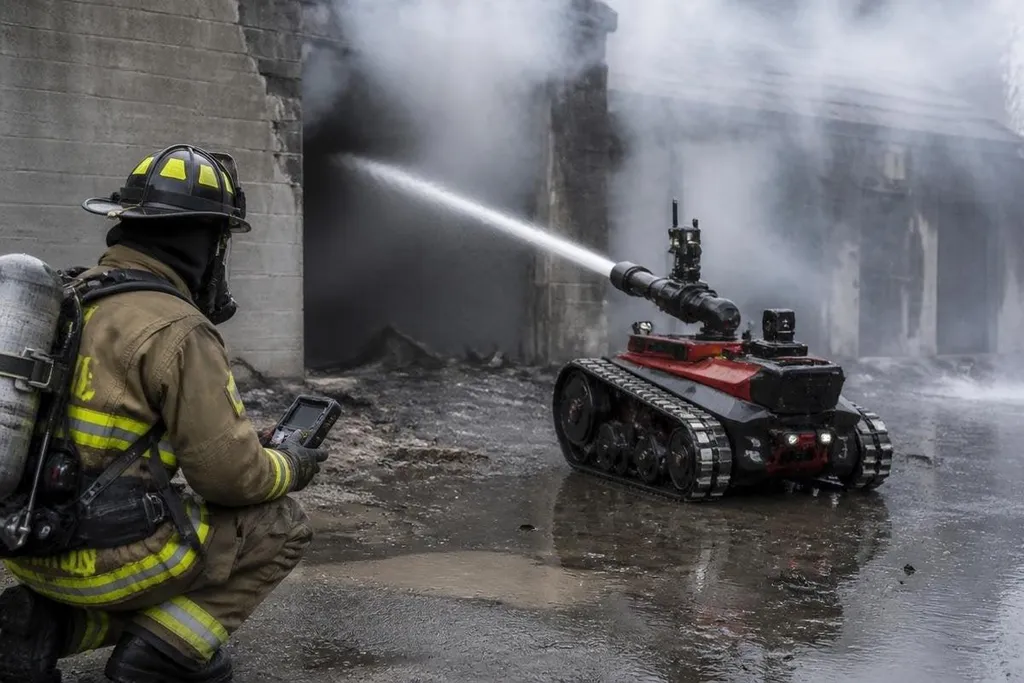
Firefighting robots will enter the work where heat, smoke, falling debris, or toxic air can stop a human crew. Their first useful role will be remote operation, with autonomy added for movement, sensing, and routine checks.
The reader's real question is practical: which jobs can a robot handle safely, and what will still need a firefighter?
- Remote water delivery: A tracked robot can carry a hose or aim a water nozzle while an operator stays outside the hottest area.
- Fireground sensing: Cameras, thermal sensors, and gas sensors can send information from rooms that are hard to enter.
- Human-led decisions: Crews will still decide where to search, when to withdraw, and how to manage people inside a building.
Where robots help first
A firefighting robot has a clear job when it can move into a dangerous area and give crews more time. A tracked platform may carry a hose, push through loose material, or send video from a structure that has already suffered damage.
Remote operation matters because the robot does not need to understand the whole building before it starts. An operator can steer it, watch its camera feed, and change direction when the scene changes. That keeps the machine useful in places where maps are missing or smoke blocks normal vision.
Its sensors add another layer of information. A thermal camera can show hot surfaces through smoke, while a gas sensor can warn about air that may harm a person. These readings don't replace a firefighter's judgment, but they can help the crew decide which doorway or passage deserves attention first.
Autonomy will grow in small steps
Full autonomy is a poor starting point for a fireground. Heat can damage sensors, smoke can hide obstacles, and water can change the floor under the robot. A machine that works well in a test building may still struggle when walls collapse or routes disappear.
The first useful autonomous functions will be narrow. The robot may keep a safe distance from an obstacle, return along its route when its radio link weakens, or hold a nozzle on a marked area. These tasks have clear limits, so a person can take control when conditions change.
That division of work also suits emergency crews.
The robot can repeat a search pattern and watch its sensors while the operator weighs fire behavior, building plans, and changing risks. That split depends on a working data link after smoke, heat, water, or debris interferes with the sensors and controls. Firefighting robot reports from Robot24.com can show which systems have faced those conditions before the article turns to the hardware.
The hardware has to survive the scene
A firefighting robot needs more than a camera and a motor. Its tracks must keep contact with wet or uneven ground, its radio link must work through walls or around vehicles, and its controls must remain usable when an operator is wearing gloves or working under stress.
Water supply creates another limit. A platform may carry a small tank for a short task, but a larger fire usually needs a hose connected to a pump. That adds cable or hose management, and the robot must avoid turning its own route into an obstacle for the crew.
Heat is also a matter of time. That machine may reach an area that people cannot enter, yet its electronics, batteries, seals, and cameras still have operating limits. Makers will need to publish those limits in clear terms, including how long the robot can work near heat and how crews recover it after a fault.
What the future still has to prove
The hard test won't be a slow drive across a clean floor. It will be repeated work in low visibility, on damaged ground, with a weak signal and a task that changes halfway through.
I’d trust a firefighting robot first as a remote tool that extends a crew’s reach, not as a replacement for the crew. That view may change when machines show long, uncut runs in real training buildings with independent safety checks.
Use this guide when you assess a system for fire service work:
- Define the task: Pick hose placement, thermal sensing, debris movement, or another job before judging the robot.
- Check the link: Test control at the distance and through the walls where the crew will use it.
- Measure recovery: Ask how the team retrieves the robot after a stalled motor, lost signal, or blocked route.
- Read the limits: Check heat exposure, battery time, water connection, sensor range, and maintenance needs.
- Keep command human: Set the point where an operator can stop, reverse, or take direct control.
The next useful proof is a field record showing how often the robot completes its task, how often crews must take over, and how long recovery takes. Until those numbers are public, firefighting robots are best bought for specific dangerous jobs rather than broad promises.